

Jul 2025
Crafting Personalised Cover Letters in Minutes: How to Leverage AI Cover-Letter Generators
That moment when you find your dream job listing? Pure excitement. Then you scroll down. "Attach cover letter". Suddenly, your palms sweat. How do you sound human when every template feels robotic? How do you stand out when recruiters spend 7 seconds scanning each letter? After helping thousands of job seekers, we can tell you: The best cover letters aren't written. They're built not from blank pages but from smart personalization. This guide shows you how to create letters that feel handcrafted in minutes, plus how our AI tools handle the heavy lifting while keeping your unique voice intact. Why Generic Cover Letters Get Trashed Recruiters spot copy-pasted letters instantly. They want: Relevance: "Why THIS role at THIS company?" Voice: Confidence without arrogance. Proof: Specific examples, not fluff. The stakes: 47% of recruiters reject applicants for unpersonalized letters. The 3-Part Cover Letter Formula 1. The Opening Hook Do this: Name-drop: After hearing CEO Jane Smith discuss [Company]’s sustainability goals on [Podcast], I knew I had to apply. Connect instantly: When I saw your need for a [Job Title] who thrives in [Specific Challenge], I immediately thought of my success at [Relevant Project]. Avoid: "I’m applying for Job ID #123…" Vague praise: "Your company is amazing!" Automate It: Our Cover Letter Generator scrapes the company’s website/linkedIn and suggests personalized openers based on their values. 2. The Body: Show, Don’t Tell Structure: 1. Link your skills to their needs: "You need someone to reduce customer churn. At [Last Co], I overhauled onboarding cutting churn by 37% in 6 months." 2. Drop proof: "I grew organic traffic 220% in 8 months similar to your goal to dominate SEO in the fintech space." Avoid: Rehashing your resume Empty claims: "I’m a hard worker!" Automate It: Paste the job description into our Cover Letter Analyzer. It flags missing skills and suggests where to add quantifiable wins. 3. The Close: Confidence Without Begging Strong: I’ve attached a case study showing how I can replicate [Result] for [Company]. Let’s schedule a call to discuss scaling your [Specific Initiative]. Weak: I hope to hear from you soon. Thank you for your time. How Our AI Tools Do the Heavy Lifting (So You Don’t Sound Like a Bot) Cover Letter Generator Features Personalization Engine: Pulls company mission/values to craft tailored hooks. Job-Matching: Auto-aligns your skills with role requirements. Tone Control: Adjusts voice (formal/approachable/energetic) in one click. ATS-Optimized: Ensures formatting stays scanner-friendly. Cover Letter Analyzer Agent Impact Score: Rates persuasiveness (1-100) and flags generic phrases. Tone Report: Highlights overused words ("passionate," "team player"). Customization Checklist: Tracks company-specific references and data points. Real Example: Before vs. After AI Optimization Before After (Using Our Tools) Opener: "I’m applying for Marketing Manager (Job #456)." Opener: *"As a longtime follower of [Company]’s viral TikTok campaigns, I was thrilled to see your need for a data-driven Marketing Manager, a role where I increased social ROI by 90% at [Previous Co]."* Body: "I managed social media and ran ads." Body: "I grew Meta ad conversions 58% using UGC videos (similar to your campaign for [Product]), earning $380K in Q4 sales." Close: "Hope to interview soon!" Close: "I’ve included a strategy for scaling your U.S. launch, let’s discuss it over coffee next week." Result: Ignored Result: Interview booked in 48 hours 3 Cover Letter Hacks Drop a "Why Them?" nugget: Your recent partnership with [X] aligns with my work at [Y] let’s discuss synergies. Quantify soft skills: Resolved 95% of team conflicts within 48 hours as project lead. End with urgency: I’ll follow up next Tuesday to share ideas for [Their Initiative]. Key Takeaway: Personalization = Less Work, Not More Great cover letters aren’t essays they’re targeted conversations. Our tools handle research, formatting, and tone so you focus on authenticity.
Jul 2025
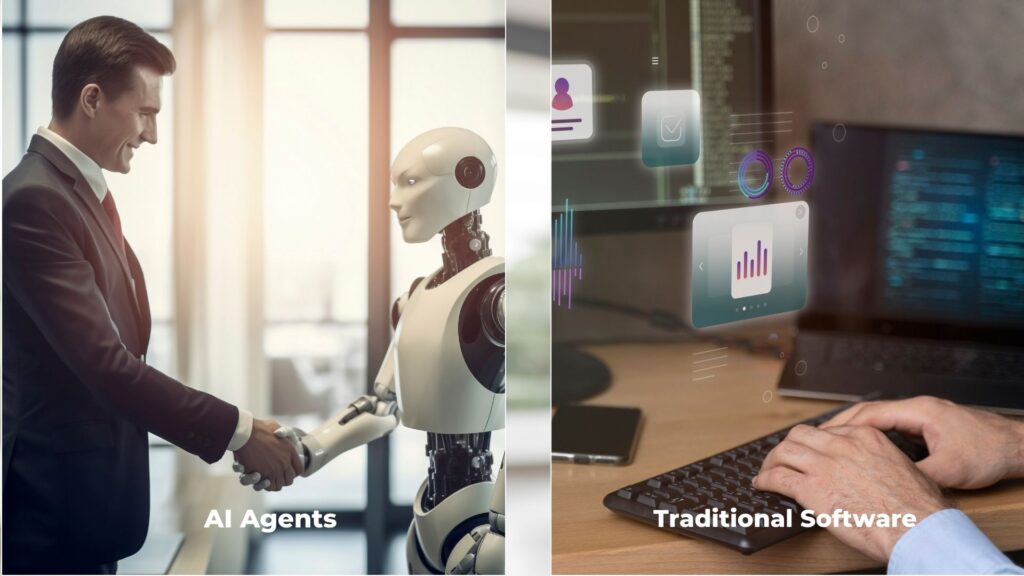
AI Agents vs. Traditional Software: A Comparative Analysis for Business Leaders
Introduction: The Evolution of Business Tools Software has been an automatic outlet in the fast-paced globe of technology. Traditional software, from a basic accounting system to CRM, has played an indispensable role in enhancing productivity, while still companies at all times relied on them. But now, Happy with the emergence of AI agents, all this is set to change. Highly intelligent assistants whose thinking processes can learn and adapt, AI agents are not automation tools but the future of business. How do AI agents compare with traditional software? Let's dive into this comparative analysis and help business leaders make the right choices. Traditional Software: Bedrock of Business In the last few decades, traditional software has been at the very core of businesses across the world. From Microsoft Office, to Salesforce or QuickBooks, the usage of these products dramatically altered the way companies work. They can be trusted, tested, and certified, with pre-defined functions users can operationalize directly from the box. The problem is, though, that traditional software, albeit effective, is static. It is bound by predefined rules and workflows and can only be changed and thus improved through human activities that update it. AI Agents: The Next Leap in Business Evolution AI agents are of a different species. Other than automating tasks, they will learn based on those data accumulated and improve with each passing day. This is unlike traditional software that has a farthest difference from AI agents as it doesn't analyze patterns or forecast results to take decisions by real-time information. More importantly, AI agents adapt to the unique needs of each business, so flexibility and capability are much more superior with them than traditional software. Key Differences Between AI Agents and Traditional Software 1. Flexibility vs. Predesigned Rules Traditional Software: Based on prefabricated workflows and rules. Once set up, it simply repeats tasks as you had initially told it to do. Users have to intervene manually and configure updates to alter their behavior. AI Agents: Learns continuously from the data that passes through it. If there’s a new trend or pattern of how the customers will behave, AI agents can automatically pick this without having to manually do so. 2. Automation Capabilities Traditional Software: For instance, can automate several repetitive tasks, such as sending out emails or generating reports, but may not and does not normally handle more complex aspects on its own and requires human intervention for much of the process. AI Agents: While it may still need human intervention at some point, AI agents can still handle complex automation tasks - such as managing an entire workflow, making data-driven decisions, as well as predicting a customer's needs. It decreases the requirement for constant human input. 3. Decision-Making Power For traditional software, it only provides tools used by humans to make decisions, yet can not make decisions on its own. It has reports and analysis available but still requires human inference. For AI agents, this generation of insights does not only stop but can also give recommendations and make proper decisions in the dynamic business environment to prompt faster decisions. 4. Customization and Flexibility Proprietary Application: Highly flexible, but major customization requires lots of development time and resources. Modifications are not easily done once it is configured. AI Agents: Can be very flexible. They can change their responses and actions relative to the preferences of the users, history, and evolving business goals. The more they learn and mature, the less they need to update and fine-tune. 5. Scalability Traditional Applications Scalability is costly and time-consuming for traditional applications. Their ability to expand user bases or increase capabilities typically leads to a commensurate requirement for more licenses or significant upgrades. AI Agents: AI agents are inherently scalable. As the business grows, AI agents can handle a heavier workload, without expensive upgrades or high infrastructure needs. 6. Cost-Effectiveness Traditional Software: Typically incurs charges for licensing the front-end, maintenance every month, and maybe upgrade costs as well. Businesses will also need to have internal IT employees who will manage the use of software. AI Agents: Although the cost of front-end deployment by AI agents can be very high, they can often improve themselves and automate complex tasks over time, which may reduce cost in the long periods, especially in aspects such as customer care, data analysis, and sales. Use Cases: Know When to Prefer AI Agents Over Traditional Software Many business leaders are confused about whether to invest in AI agents or stick to traditional software. The bottom line to that answer comes from the specific needs of the business. Here are a few common use cases where AI agents are considered a better choice than their traditional counterparts: Customer Support: AI agents like chatbots can provide 24/7 customer support because queries can be quickly answered and possibly issues are resolved that cannot happen in systems with human involvement and traditional support systems. Sales and Marketing: AI-powered lead generation tools can automatically find and nurture leads based on real-time data, something no traditional CRM system can guarantee without really significant customization. Operational efficiency: AI agents assist in fine-tuning supply chain processes, monitor real-time data, make adjustments on the fly, minimize delays more dramatically than ERP systems can by default, and thus increase productivity to a significantly higher extent. Challenges and Limitations AI agents come with their challenges and limitations. The agents draw only the best data available and require infrastructure to function well; the business has to invest in the infrastructure of various AI tools. Ethical dilemmas are another challenge; in hiring and in customer service, for example, AI may pose problems regarding the decision-making algorithms. Conclusion: The Future of Business Efficiency In this war between AI agents and traditional software, the upper hand is not one over the other-it's about having the right tool for the job. Traditional software has played wonders for businesses in their current form for decades, but AI agents offer businesses new opportunities if they are willing to adapt, scale, and climb up the ladder of competition in a competitive market depending on the decision made to know where investments should be focused. The future, therefore, lies not only in the substitution of AI agents but also in how well both worlds integrate to create efficiency, responsiveness, and innovation in the workplace. More winners than losers will be the businesses that know which of each world to harness well.